.png)
Bookkeeping vs. Accounting: What's the Difference, and Which Does Your Business Need?

Updated: 5 days ago
"Know Your Numbers, Run Your Business with Confidence"
Quick Answer
Bookkeeping records and organizes your financial transactions day to day. Accounting interprets that information to analyze performance and support planning. Most businesses need accurate bookkeeping first, since reliable analysis depends on trustworthy books. Whether you also need accounting depends on your size, industry, complexity, and goals.
If you've ever said "I need to get my books done" and "I need to talk to my accountant" in the same breath, you're not alone. Most business owners use bookkeeping and accounting interchangeably. They're related, but they aren't the same thing. Knowing the difference helps you figure out what kind of financial support your business actually needs, so you don't pay for the wrong thing or go without the right one.

What Is Bookkeeping?
Bookkeeping is the day-to-day work of keeping your financial records accurate and current. It's the foundation everything else is built on. Bookkeeping typically includes:
Recording income and expenses
Categorizing transactions
Reconciling bank and credit card accounts
Recording sales
Managing accounts payable (the bills you owe)
Managing accounts receivable (the money owed to you)
Supporting payroll
Keeping your financial records organized and accurate
It isn't glamorous, but it's the work that tells you where your money came from and where it went.
What Is Accounting?
Accounting takes the information bookkeeping produces and interprets it. Where bookkeeping records what happened, accounting asks what it means and what to do about it. That can include analyzing financial performance, evaluating results, and supporting planning and strategy.
One caution: "accounting" covers a lot of ground, and not every accounting provider offers the same services. Some focus on tax preparation, others on advisory work, others on something in between. If you're hiring one, ask exactly what's included.
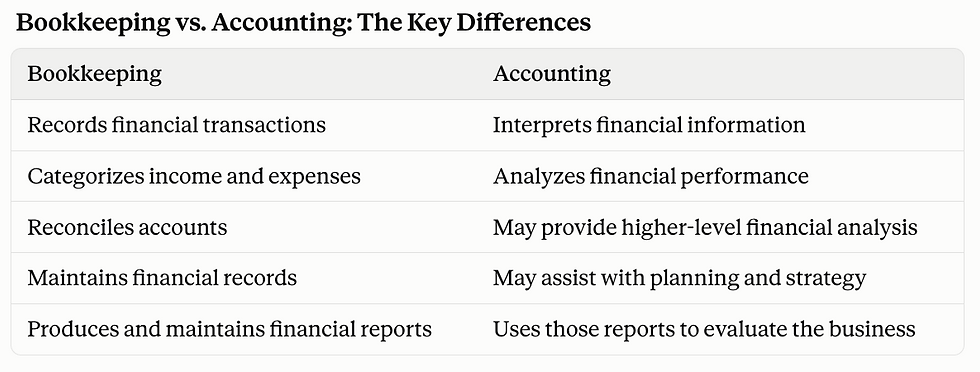
Bookkeeping builds the picture.
Accounting helps you read it.
Why Your Business Needs Accurate Bookkeeping First
Here's what I tell business owners: you can't make good decisions from financial information you don't trust.
If transactions are miscategorized, reconciliations are behind, or reports are weeks (or months) late, then any analysis built on top of them is shaky, no matter how smart the analyst is. Accurate, timely books let you see your revenue, expenses, profitability, and cash flow as they really are. That clarity is where better decisions start, and it's a big part of the peace of mind that comes with it.
A Practical Example From My Experience
I saw just how important keeping up with your books can be when I took on one of my largest cleanup projects — a $42,000 engagement to bring a business owner's financial records up to date.
The owner hadn't maintained books or filed federal tax returns for roughly 10 years. The issue wasn't that the books were messy — there simply weren't current books to work from. Bringing years of financial activity together and getting the business back on track was a significant undertaking.
It was also a powerful reminder of how quickly something that gets put off "until later" can become a much bigger project. Keeping your bookkeeping current isn't just about having organized records. It's about knowing where your business stands today and avoiding a much bigger problem tomorrow.
When Should You Hire a Bookkeeper?
Most owners wait too long. Here are some signs it's time:
You're behind on your books
Reconciliations aren't getting done
You don't understand your financial reports
You're spending too much of your own time on bookkeeping
Your transaction volume has increased
You've added employees
You're opening another location
You have multiple revenue streams
You're preparing for growth
If even one of these sounds familiar, handing off the books can give you back nights and weekends, and give your numbers the attention they deserve.
Do Restaurants Need Specialized Bookkeeping?
In my experience, yes. Restaurants aren't like other small businesses, and the books shouldn't be treated as if they are. Restaurant bookkeeping means making sense of:
POS systems and how they connect to your books
Multiple revenue streams, from dine-in to catering to takeout
Tips
Sales tax
Food costs and inventory
Waste
Labor
Vendors, often many of them, with frequent changes
Delivery platforms
Prime cost, the combination of food and labor that can make or break your margins
A bookkeeper who doesn't speak this language can easily miss what's happening in your numbers. A restaurant can look busy and still be losing ground, and the books are where you find out why.
From Numbers to Decisions: A Restaurant Example
I have a restaurant client who is a great example of why being busy doesn't always mean being profitable. His tables are full, customers love the food, and sales are strong — yet he's still struggling from week to week.
Why? His food and labor costs are too high.
When you're running a restaurant, it's not enough to look at sales and think, "We're having a good month." You need to understand what's happening underneath those sales. How much are you spending on food? How much are you spending on labor? Are those costs staying in line with your revenue? And where are you losing margin?
That's where restaurant-specific bookkeeping becomes so valuable. The goal isn't simply to record what happened. It's to help the owner see what the numbers are telling him so he can make informed decisions about where to make changes.
What Does a Bookkeeper Actually Give You?
It's easy to think of bookkeeping as a list of tasks. What you're really getting is a chain of value:
Accurate books → reliable reports → financial clarity → better decisions.
The tasks matter, but the outcome is what counts: knowing where you stand, spotting problems early, and feeling confident about your next move instead of guessing.
Does Your Business Need Bookkeeping, Accounting, or Both?
I won't tell you everyone needs the same thing, because they don't. The right answer depends on:
Your business size
Complexity
Your industry
Transaction volume
Number of employees
Your financial goals
Whether you already have a CPA or accountant
Whether you need ongoing bookkeeping, financial analysis, or both
If you already work with a tax professional or accountant, great. Good bookkeeping makes their job easier, and I'm happy to work alongside them where it makes sense. Clean books mean less back-and-forth and fewer surprises at tax time.
How upWard Bookkeeping Solutions Can Help
Every business is at a different starting point, so I've built four ways to work together:
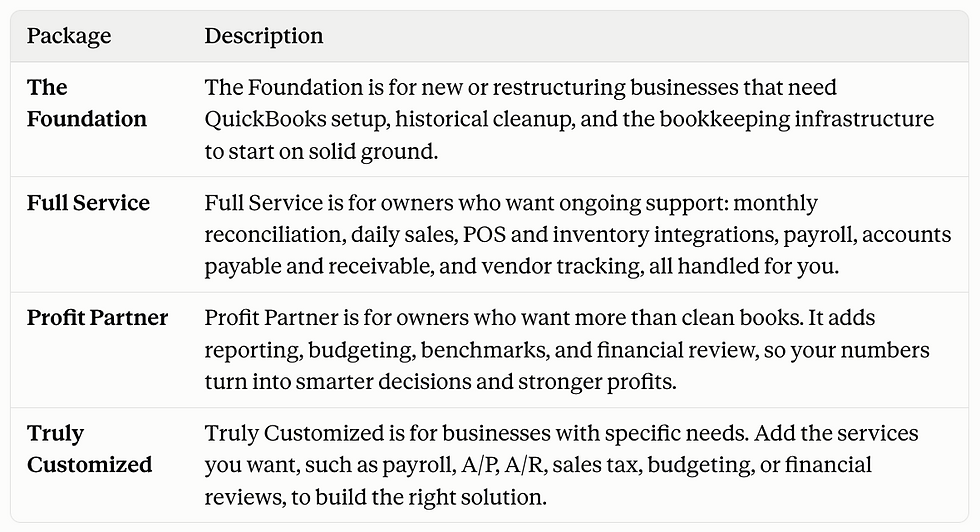
Not sure which fits? That's what the free consultation is for. We'll talk through where your books stand today and what would help most.
Schedule your free consultation and let's get your numbers working for you.

Have more questions? Check out the full upWard FAQ page for more on how virtual bookkeeping works.
Frequently Asked Questions
What is the main difference between bookkeeping and accounting?
Bookkeeping records and organizes your financial transactions. Accounting interprets that information by analyzing performance and supporting planning and strategy. Bookkeeping builds the picture, and accounting helps you read it.
Do I need a bookkeeper if I already have an accountant?
Possibly. Accountants work from the records bookkeeping produces, and clean books mean less back-and-forth and fewer surprises at tax time. A bookkeeper can work alongside your accountant or tax professional.
When is it time to hire a bookkeeper?
Common signs include being behind on your books, skipped reconciliations, not understanding your financial reports, spending too much of your own time on bookkeeping, or growth such as more transactions, new employees, another location, or multiple revenue streams.
Why does bookkeeping have to come before accounting?
Analysis is only as good as the data behind it. If transactions are miscategorized or reports are late, any analysis built on them is unreliable.
Do restaurants need specialized bookkeeping?
Yes. Restaurants deal with POS integrations, multiple revenue streams, tips, sales tax, food costs, inventory, waste, labor, delivery platforms, and prime cost. A restaurant can look busy and still lose ground, and specialized books show why.
What happens if I fall behind on my books?
Small delays can become big projects. In one cleanup engagement, an owner had gone about 10 years without maintained books or filed federal tax returns, and bringing the records current was a $42,000 project.
What should I ask when hiring an accounting provider?
Ask exactly what's included. Some providers focus on tax preparation, others on advisory work, and others on something in between.
Which upWard Bookkeeping Solutions package is right for me?
It depends on your business size, complexity, industry, transaction volume, and goals. The free consultation is the best way to find the right fit.

Comments