
Why Your Bank Balance Isn’t Your Profit (and What to Look at Instead)

Understanding the Gap Between Cash Flow and True Profit
Quick Answer
Your bank balance shows how much cash is in your account today. Your profit shows whether your business earned more than it spent over a period of time. They’re different numbers, and they often tell very different stories. To understand how your business is really doing, look at your Profit & Loss statement, your Balance Sheet, and your cash flow together, not just your bank balance.
If you’ve ever looked at your bank account, seen a healthy balance and thought, “We must be doing great,” you’re not alone. It’s one of the most common things I hear from business owners. It’s also one of the easiest ways to get blindsided.
A bank balance feels like the truth because it’s real money you can see. But it’s only a snapshot of one moment, and it leaves out a lot.

What Your Bank Balance Actually Tells You
Your bank balance tells you one thing: how much cash you have right now. It doesn’t tell you:
What you owe that hasn’t been paid yet
Whether you earned a profit this month
Which money is really yours to keep
Whether your costs are creeping up
It’s a useful number, but it’s not a measure of success.
Why Your Bank Balance and Your Profit Don’t Match
Here are the most common reasons I see the two numbers drift apart:
Timing. You may have bills you haven’t paid yet, or money customers owe you that hasn’t arrived. Your bank balance won’t show either one.
Sales tax and tips. Sales tax you collect and tips you hold for employees pass through your account, but they aren’t yours.
Loans. A loan deposit raises your bank balance but isn’t income. The principal portion of a loan payment lowers your balance but isn’t an expense.
Owner draws and contributions. Money you take out or put in changes your cash, not your profit.
Inventory and equipment. Buying a big order of inventory or a piece of equipment can empty your account without being a loss.
Payouts that arrive net. Delivery platforms and card processors often deposit sales after taking fees, and on a delay.
What Happens When You Don't Keep Up With Your Books?
I've seen firsthand how important it is to stay on top of your business finances. One of my largest engagements was a $42,000 cleanup project for a business owner who had gone roughly 10 years without maintaining books or filing federal tax returns.
When you don't have accurate financial records, it's difficult to know where your business stands, what you owe, or whether you're actually making money. And the longer you go without that information, the more complicated getting caught up can become.
You shouldn't have to wait until your finances become a major problem to understand what's happening in your business. Keeping your books current gives you the information you need to make informed decisions today, rather than trying to piece everything together years down the road.
A Simple Example
Here’s an illustration of how this plays out.
Imagine a business owner looks at her account at the end of the month and sees $25,000. Feels great. But sitting inside that number:
$4,000 in sales tax she’s collected and still needs to send to the state
$9,000 in vendor bills that haven’t been paid yet
$6,000 in payroll taxes coming due
That leaves roughly $6,000 she can actually call her own, and that’s before asking whether the business made a profit at all. Same bank balance, very different reality.
What to Look at Instead
When I sit down with an owner, I don’t start with the bank balance. I start with these:
1. Your Profit & Loss (P&L). This shows your income and expenses over a period, and whether you made or lost money. It’s the closest thing to a true profit number, but only if your books are accurate and up to date.
2. Your Balance Sheet. This shows what you own, what you owe, and what’s left. It’s where those unpaid bills, loans, and tax liabilities show up, the things your bank balance hides.
3. Your cash flow. Cash flow shows how money moves in and out over time, so you can plan ahead instead of being surprised.
4. Budget vs. actual. Comparing what you expected to what really happened is where you spot problems early.
Together, these give you the full picture. Any one of them alone can mislead you.
The Real Value Is Understanding What the Numbers Mean
Having a Profit & Loss statement is a good start, but simply looking at the report doesn't automatically tell you what to do next. Are expenses increasing faster than revenue? Are your margins shrinking? Are you generating enough cash to cover upcoming obligations? And if something has changed, do you know why?
These are the questions worth asking. Your financial reports give you the information, but reviewing the trends and understanding what's driving them helps you make better business decisions.
What About Restaurants?
This matters even more in restaurants. A busy dining room and a full cash register can hide thin margins, because so much cash moves through the business: tips, sales tax, delivery platform payouts, and constant vendor payments.
A Busy Restaurant Doesn't Always Mean a Profitable One
I have a restaurant client who is a perfect example of this. His tables are full, customers love the food, and the restaurant is bringing in sales. From the outside, it might look like everything is going great. But behind the scenes, he's still struggling week to week because his food and labor costs are too high.
This is something restaurant owners need to pay attention to. Strong sales don't automatically translate into strong profits. If too much of your revenue is going toward food, labor, and other operating expenses, you can be working incredibly hard and still have very little left over.
That's why understanding your numbers matters so much. You need to know not only how much money is coming in, but also where it's going and how much you're actually keeping. When you understand your costs and monitor them consistently, you have a better chance of identifying problems and making changes before they become bigger financial challenges.
That’s why restaurant owners need to look underneath the sales and watch their prime cost, the combination of food and labor. When those two costs creep up, your bank balance may look fine for a while, right up until it doesn’t. The books are where you find out why before it becomes a cash problem.
Why Accurate Books Come First
None of these reports are useful if the books behind them aren’t current and correct. If transactions are miscategorized or reconciliations are behind, your P&L can tell you the wrong story, and you’ll make decisions based on it. Accurate books lead to reliable reports, which lead to financial clarity and better decisions.
How upWard Bookkeeping Solutions Can Help
Every business is at a different starting point, so I've built four ways to work together:
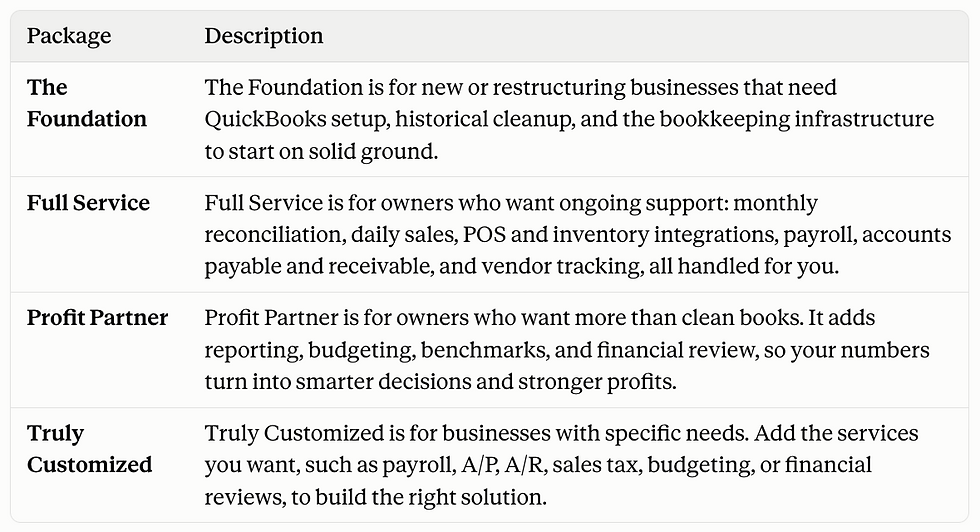
Not sure which fits? That's what the free consultation is for. We'll talk through where your books stand today and what would help most.
Schedule your free consultation and let's get your numbers working for you.

Have more questions? Check out the full upWard FAQ page for more on how virtual bookkeeping works.
Frequently Asked Questions
Why isn’t my bank balance the same as my profit?
Your bank balance reflects cash at a single moment. Profit measures what your business earned versus what it spent over a period. Timing, taxes, loans, owner draws, and inventory purchases all affect cash without affecting profit the same way.
Can I be profitable and still run out of cash?
Yes. A business can show a profit on paper and still struggle with cash if customers pay slowly, bills come due at once, or money goes into inventory, equipment, or loan payments.
Can I have a lot of cash and still not be profitable?
Yes. A loan deposit, a pile of unpaid bills, or collected sales tax can make your account look strong while the business is actually losing money.
What reports should I look at each month?
At a minimum, your Profit & Loss statement, Balance Sheet, and a view of cash flow. Comparing actual results to a budget is also very helpful.
Why does this matter so much for restaurants?
Restaurants handle high volumes of cash movement, tips, sales tax, delivery payouts, and many vendors. Food and labor costs (prime cost) can erode profit quietly, even when sales look strong.
How do I know if my books are accurate enough to trust?
If your reconciliations are current, transactions are categorized correctly, and your reports arrive on time and make sense to you, you’re in good shape. If not, a bookkeeping review is a good first step.



Comments